
As Warsh’s Fed faces pressure to act on inflation, these indicators show it’s at its lowest

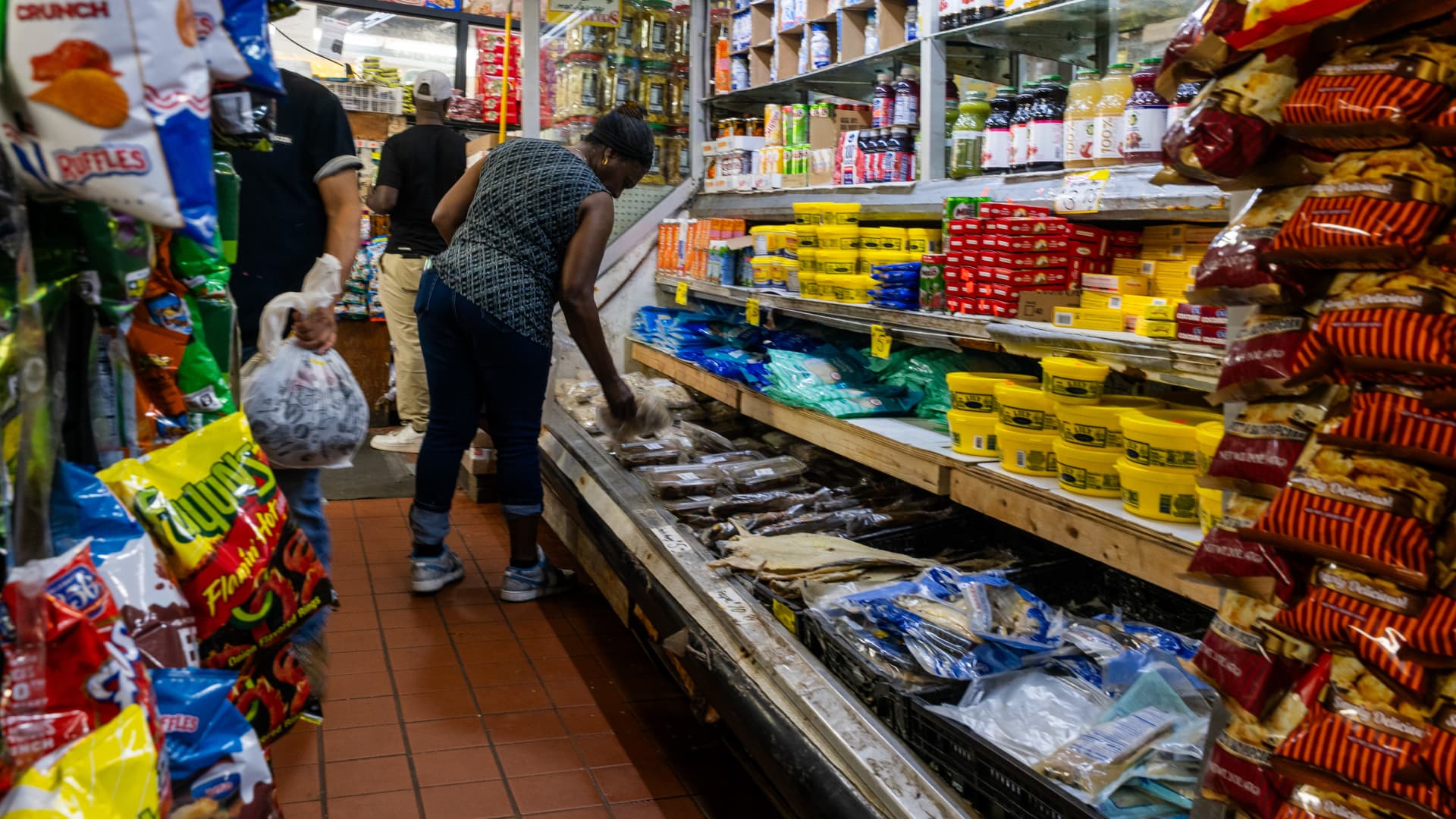
People shop for groceries at a store in Brooklyn on July 13, 2026 in New York City.
Spencer Platt | Getty Images
Pricing data from June indicated that outside of some select items where costs continue to grow, inflation is trending back towards the Federal Reserve’s inflation goal.
So-called trimmed mean measures, which exclude outliers in both price increases and decreases, showed inflation at its lowest since the early part of the decade.
The Dallas Fed’s measure, in fact, puts the one-month annualized rate for June at just 1.4%, down a whopping 1.3 percentage points from May and at its lowest level since November 2020.
Further, the 12-month rate, which Fed policymakers watch more closely, dipped to 2.2%, down 0.2 percentage point from a month ago to a bottom not seen since July 2021.
While Fed officials are quick to stress that they don’t focus on one month of any data point, the trend in the trimmed mean could get some attention, particularly in light of Chairman Kevin Warsh’s intention to reexamine how the central bank views inflation and what data points it employs.
Trimmed mean data “should also now fall closer to target-consistent rates,” Citigroup economist Andrew Hollenhorst said in a note.
“The fact that underlying inflation is still slowing toward target – as indicated by a broad set of indicators – is now even more relevant given Chair Warsh’s suggestion that he would analyze inflationary pressure by looking across a broad range of metrics,” he added. “We expect markets to price-out rate hikes in coming months on inflation data, and price-in cuts if the unemployment rate rises as we project.”
How it works
The trimmed mean inflation measures essentially act like a teacher grading a test on a curve: In the case of the Dallas measure, it tosses out 24% of the lower-end price readings and 31% at the high end to come up with a better midpoint of where inflation is absent outliers.
The measure specifically uses the personal consumption expenditures price index — the Fed’s primary inflation forecasting tool — results of which were released Thursday. The Commerce Department said the all-items index fell 0.1% for the month, largely on a sharp decline in fuel costs, while the core level that excludes food and energy gained 0.1%. On an annual basis, the two gauges rose a respective 3.7% and 3.3%.
Similarly, the Cleveland Fed has a “16% trimmed mean” that includes price changes below the 92nd percentile and above the 8th percentile. That measure, though, uses the consumer price index as its benchmark. For June, the trimmed CPI was at 2.63%, which, on an unrounded basis, was the lowest since May 2021.
While such measures could get more prominent placement on the Fed’s dashboard under Warsh, there are a number of caveats.
For one, Lorie Logan, who as Dallas Fed president oversees its trimmed mean measure, has cautioned about reading too much into it because of compositional factors at play.
Specifically, she said her researchers have found “that a change in the mix of price increases and decreases is causing the trimmed mean to drop too many increases right now. This effect likely makes the trimmed mean lower than the true inflation trend.”
Inflation skepticism
Logan, in fact, this week dissented from the Federal Open Market Committee’s decision to keep its benchmark interest rate steady, preferring instead a quarter percentage point increase to address inflation that has been running above target for more than five years.
“Even after accounting for productivity gains and temporary supply shocks, inflation appears to be trending toward the mid-2’s, not all the way to 2 percent, and the risks are to the upside,” she said in a statement Friday.
Logan was joined in her dissent by regional Presidents Neel Kashkari of Minneapolis and Beth Hammack of Cleveland, both of whom said inflation is uncomfortably high and the Fed should act now rather than wait.
Markets this week also focused on the headline inflation numbers — and a perception that the Fed’s decision not to hike could exacerbate things. Bond yields surged, particularly at the long end of the duration curve where investors try to price in future growth and inflation prospects.
Warsh himself voiced only halting confidence in the current trajectory of inflation, citing some potentially positive signs from production, but insisted that the Fed still has a lot of work to do.
“Not one of my FOMC colleagues is under any illusion,” the chairman said. “We have begun a new chapter, and we understand that the five-plus years of inflation above target cannot be cured in nine weeks — or by a single month of modest price decreases.”
This article was originally published by a Cnbc.com. Read the Original article here. .


