You’re Probably Looking at the Wrong Quantum Computing Stocks

The $2 billion the government just deployed tells you exactly which layer of the market wins first
Listen to the audio version of this article (generated by AI).
What happens when two governments both reach for their checkbooks in the same week, and both bet on the factories, not the machines?
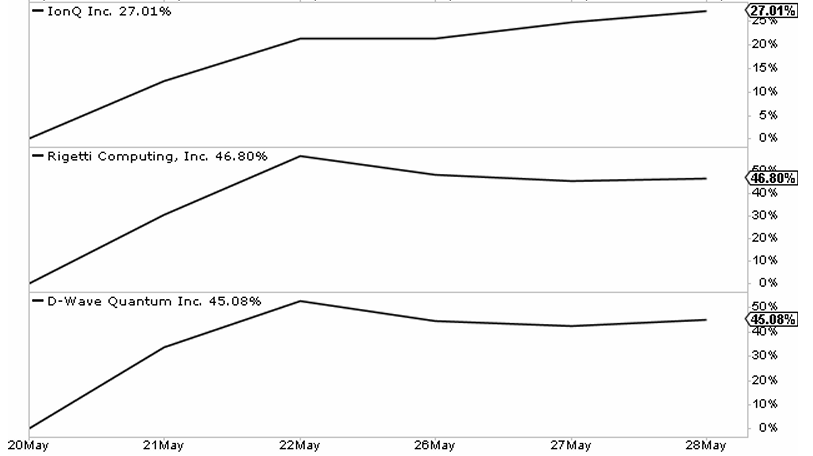
On May 21, the Department of Commerce signed letters of intent with nine quantum companies, totaling $2.013 billion in funding, taking equity stakes as it went. Commerce Secretary Howard Lutnick called it “a new era of American innovation.” Markets agreed… quantum stocks rose double-digits overnight, and some are now up ~50% since.
The very next morning, President Emmanuel Macron stood in a supercomputing center south of the city and committed another billion euros to France’s own quantum strategy. Dropping the diplomatic niceties, Macron boasted “we have the means to be the winners of this race.”
The French reply wasn’t just speedy… it’s effectively a weight scale, weighing the heft of how seriously the world now takes the American hand. Look over the past decade and you’ll see how governments treated quantum the way they’d treat any laboratory curiosity… with a grant here, a national lab there… This time, the global response frames quantum as territory worth defending.
If investors stopped reading there, they shouldn’t have…
Washington sent two messages this week:
- Quantum is a national priority.
- Here’s exactly which part of the industry matters most.
One of those messages will move stocks tomorrow. The other will make investors wealthy.
The CHIPS Act Playbook Is Running Again — This Time In Quantum
Back in 2022, Congress passed the CHIPS and Science Act to ostensibly bring semiconductor manufacturing back to American soil.
The government cited national security and supply chain resilience. Its unstated rationale? China is coming for advanced computing, and we’re not going to let them have it.
Quantum is now getting the same treatment. And the funding architecture is almost identical. The two largest checks — $1 billion to IBM (IBM) and $375 million to GlobalFoundries (GFS) — go not to quantum computer makers but to quantum foundries.
The Headline Stocks Aren’t the Headline Trade
IBM is standing up a new subsidiary called Anderon to build America’s first dedicated quantum wafer fabrication facility, matching the government’s investment with another $1 billion of its own capital. Anderon is a superconducting-first bet — which means IBM is more exposed than GlobalFoundries to any future architecture shift. That’s a risk worth knowing. But IBM’s roadmap is currently the most mature in the industry, and the manufacturing backstop meaningfully de-risks the scaling timeline.
GlobalFoundries is building a multi-modality foundry — a facility capable of manufacturing across five distinct quantum hardware approaches: superconducting circuits, trapped ions, photonics, topological qubits, and silicon spin. Each is a competing bet on how quantum computers will ultimately be built. Rather than picking a winner, GlobalFoundries is positioning to supply all of them — the quantum equivalent of a fab that makes chips regardless of which processor architecture dominates.
The remaining $638 million flows to seven other quantum computing companies — D-Wave (QBTS), Rigetti (RGTI), Quantinuum, Infleqtion (INFQ), Atom Computing, PsiQuantum, and Diraq — each receiving between $38- and $100 million to advance their proprietary hardware and error correction work.
It’s a venture portfolio with a lead check. IBM and GlobalFoundries get the anchor rounds. The seven computing firms are the seed and Series A bets.
This is exactly the same playbook Washington ran on classical semiconductors — and investors who understood that Taiwan Semiconductor (TSM), ASML (ASML), and Lam Research (LRCX) were the real plays made far more money than those who bought PC makers.
The AI Infrastructure Playbook Already Told Us How This Ends
The parallel here should feel very familiar.
When AI started its current boom cycle, there were two ways to play it. You could buy the AI applications — the companies building large language models and AI-native software. Or you could buy the AI infrastructure — the companies building the GPUs, custom ASICs, networking fabric, and power infrastructure that AI runs on.
We know how that story turned out…
Nvidia (NVDA) stock went from $300 to $1,200. Broadcom (AVGO) projects $100 billion-plus in AI revenue by 2027. Marvell (MRVL) is targeting $15 billion by FY2028. The infrastructure layer — the picks-and-shovels trade — has dramatically outperformed the application layer because it wins regardless of which AI model or product dominates.
The same dynamic is forming in the quantum space. We don’t yet know whether superconducting qubits, trapped ions, photonics, or neutral atoms will be the dominant architecture of the fault-tolerant quantum era. That’s an open question. But we do know that all require quantum-grade wafer fabrication, cryogenic components, specialized materials, and precision manufacturing at scales that don’t yet exist. The foundry layer wins regardless.
In AI, the GPU makers got rich before the AI applications did. In quantum, the foundry builders will get there before the quantum computer makers do.
What $2 Billion Actually Buys — and What It Doesn’t
This government check doesn’t solve the fundamental physics of quantum computing.
The core obstacle to truly fault-tolerant quantum machines is qubit coherence — the ability of a qubit to maintain its quantum state long enough to be useful. Qubits are extraordinarily sensitive to heat, vibration, and electromagnetic interference; the slightest disturbance causes errors. Today, you need hundreds of imperfect physical qubits working in concert to produce a single reliable logical qubit. That’s a fundamental physics constraint, not a capital problem.
What this investment does buy is iteration velocity. Dedicated quantum foundries mean researchers can prototype, test, refine, and scale hardware designs faster. It’s an accelerant for R&D.
It also builds the talent pipeline and domestic supply chain that didn’t exist before. A purpose-built quantum foundry creates quantum-literate engineers, specialized materials suppliers, and institutional process knowledge — the ecosystem infrastructure that always precedes commercial breakthroughs. For example, DARPA’s early bets on networking and computing looked premature for years — then became the foundation of the modern internet. The investors who built around that ecosystem captured the value. The ones who waited for certainty missed it.
This capital doesn’t dramatically change the timeline for utility-scale, fault-tolerant quantum systems. But it does change who owns the ecosystem when that window arrives — and increasingly, that answer is the United States.
The Quantum Computing Stocks Worth Owning Right Now
So what do you actually do with this information?
IBM is the most direct quantum infrastructure bet that trades as a liquid public stock. The Anderon foundry — $2 billion capitalized between government grant and IBM match — is a serious enterprise. IBM’s quantum roadmap is the most advanced in superconducting qubits, and it now has the manufacturing backstop to scale it. The quantum story isn’t why you buy IBM today, but it’s becoming a more credible option value embedded in the stock.
GlobalFoundries is the sleeper here. Its $375 million award funds a multi-modality quantum foundry — meaning it’s positioned to serve all architectural approaches rather than betting on one. GFS already has the semiconductor manufacturing expertise; it’s now being paid to apply it to quantum.
D-Wave and Rigetti get $100 million each, which is meaningful for companies of their size — and the government’s equity stake is a credibility signal that should improve their institutional investor access. Both remain speculative, pre-profitability plays. But they’re now speculative plays with a powerful customer and shareholder in Washington.
The Factories Win Before the Computers Do
The quantum infrastructure layer is where the durable wealth creation will come from, just as it has in AI.
Pure-play quantum compute names are high-optionality bets on which technology wins. Foundry and manufacturing names are bets on the category winning — and that bet just got a billion-dollar government co-sign.
The $2 billion CHIPS Act investment — structured around foundry infrastructure rather than raw compute — mirrors the exact playbook that produced the AI infrastructure supercycle. And the lesson of the AI era is clear: when a transformative computing paradigm arrives, the factories win before the computers do.
Washington just started building the quantum factories. The picks-and-shovels moment is here.
That pattern doesn’t stop at quantum computing.
I’m watching it unfold right now in a market most investors aren’t paying attention to — something older than semiconductors, older than AI, older than the internet. And its infrastructure is being rebuilt from scratch for the first time in a generation.
Here’s what I’m watching — and why I think it may be the most important investment story of the decade.